What Is a Bomb Pot? Rules, Variations and Strategy

A bomb pot is a poker hand where every player at the table puts in the same agreed ante, there is no preflop betting, and the dealer goes straight to the flop. You start with a big, multiway pot and play the rest of the hand as normal. Clubs run bomb pots because they create action, build big pots fast and keep tables lively.
If you play in online clubs on apps like ClubGG, you will run into bomb pots sooner or later, often as scheduled hands or as a regular feature at action tables. Below are the exact bomb pot rules, the common variations (including double board and PLO bomb pots) and the strategy changes that matter most.
How does a bomb pot work? Step-by-step bomb pot rules
The rules are simple, and the same in most games:
- Every player antes the same amount. The amount is set in advance, usually as a multiple of the big blind. Everyone dealt in pays it, including the players in the blinds.
- Hole cards are dealt as usual. Two cards in Hold'em, four in PLO, five in PLO5.
- There is no preflop action. Nobody can raise, call or fold before the flop. The antes are the entire preflop pot.
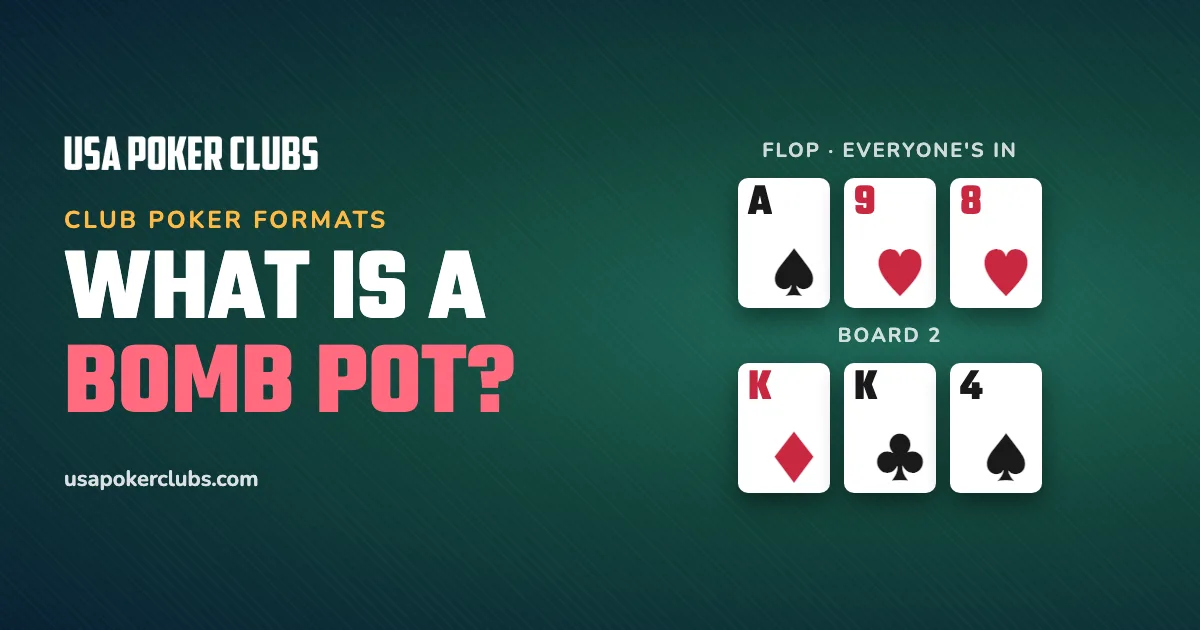
- The flop is dealt. In a double board bomb pot, two separate flops are dealt.
- Betting starts on the flop. The first active player to the left of the button acts first, exactly like a normal postflop street.
- The rest of the hand plays normally. Turn, river, betting rounds and showdown all follow the standard rules of the game.
That's it. The only real difference from a normal hand is that the preflop round is replaced by a forced, equal contribution from everyone at the table.
Why clubs run bomb pots
Bomb pots exist to make games more fun. Every player sees a flop, pots are big from the start, and players who have been folding for an orbit get a reason to stay engaged. For a club, that means livelier tables and longer sessions.
On club apps, bomb pots are usually set up by the table or the club rather than agreed at the table. Many clubs on ClubGG run scheduled bomb pots, for example one every orbit or at set intervals, and some tables offer double board bomb pots as well. The exact setup varies by club and table, so check the table info before you sit down. If you are looking for a club that spreads action games, our club directory lists Club IDs, stakes and game types.
Common bomb pot variations
Ante size
The ante decides how much the bomb pot changes the game. A small ante (around two big blinds) adds a little action. A large ante (five big blinds or more) creates a pot so big relative to stacks that many hands end with someone all-in by the turn. Look at the ante before you look at your cards.
Double board bomb pot
A double board bomb pot deals two boards at once. Each street adds one card to each board, and every betting round covers both boards together. At showdown the pot is split in half: one half goes to the best hand on the top board, the other half to the best hand on the bottom board.
If you have the best hand on both boards, you scoop the whole pot. If you win one board, you get half. If two players tie on a board, that board's half is split between them, which is how you can end up with a quarter of the pot.
PLO bomb pot and PLO5 bomb pot
Bomb pots are especially popular in Pot-Limit Omaha. With four (or five) hole cards, every player connects with the flop more often, so a PLO bomb pot produces more draws, more big hands and more action than a Hold'em one. Double board PLO bomb pots are a common format in action-heavy clubs. If you are new to these games, our guide to ClubGG game types and hand rankings covers the basics, and our post on PLO5 beginner mistakes covers five-card Omaha.
Bomb pot variants at a glance
| Variant | Hole cards | Boards | How the pot is won | What changes most |
|---|---|---|---|---|
| NL Hold'em bomb pot | 2 | 1 | Best hand takes it all | Top pair loses value multiway |
| Double board Hold'em | 2 | 2 | Half per board | Scooping both boards is the goal |
| PLO bomb pot | 4 | 1 | Best hand takes it all | Draws are huge; second-best flushes lose big |
| Double board PLO | 4 | 2 | Half per board | Chopping and quartering are common |
| PLO5 bomb pot | 5 | 1 or 2 | Best hand (half per board on double board) | Nut hands are needed even more often |
Bomb pot strategy
Because nobody chose to play their hand, bomb pot strategy is mostly about adjusting to three facts: everyone's range is random, the pot is multiway, and the pot is large compared with the stacks behind.
Every range is wide, and that includes yours
Your opponents have not shown any preflop strength, so their ranges are as wide as the deck. That cuts both ways. They are far less likely to have a premium pair, but with five or more random hands in play, someone often flops something strong. Don't assume a bet means a bluff just because ranges are wide.
Why top pair is weak multiway
In a heads-up raised pot, top pair is often good. In a six-way bomb pot it is usually a hand that wants to see a cheap showdown, not one that wants to get all-in. With five opponents, the chance that someone has two pair, a set or a better kicker goes up sharply, and the draws are out there too. Play top pair for pot control and be ready to let it go to heavy action.
Play for the nuts
The hands that make money in bomb pots are nut hands and strong draws to the nuts. In Hold'em that means sets, two pair with a solid board, straights and big combo draws. In PLO bomb pots it means nut flushes, the nut straight and sets with redraws. A second-best flush in a multiway PLO pot is one of the most expensive hands in poker.
Understand SPR (stack-to-pot ratio)
SPR is the effective stack divided by the pot on the flop. A low SPR means you are committed with fewer hands; a high SPR means you need a stronger hand to stack off.
Example at $1/$2: six players each ante $10 from $210 stacks. The flop pot is $60 and everyone has $200 behind, so the SPR is 200 / 60, or about 3.3. Compare that with a normal hand where you open to $6, one player calls and the blinds fold: the pot is $15 and stacks are $204, an SPR of about 13.6.
With an SPR near 3, a pot-sized bet on the flop and one more on the turn gets the money in. So decide early: if your hand is not good enough to go all the way, don't build the pot.
Double board: scoop, don't chop
On double board, a hand that is strong on only one board is worth a lot less than it looks. Your real goal is scooping. Prefer hands that are good on both boards or that have strong draws to both. When you are only playing for half, keep the pot small.
Bomb pot strategy in action: two worked examples
Example 1: Hold'em bomb pot, top pair and a big draw
$1/$2 table, six players, $10 ante each, so $60 in the pot with $200 behind. You hold K♥9♣ and the flop is K♠8♦4♣.
You have top pair with a weak kicker. Against five random hands, plenty of holdings beat you: any king with a better kicker, K8, K4, 84, and sets. A small bet or a check is fine, but if you face a bet and a raise, folding is usually right. You only have about $200 behind, so calling down "to see where you are" can cost you your stack.
Now change your hand to 7♠6♠ on 8♠5♦2♠. You have a flush draw plus an open-ended straight draw: any spade (9 outs) or any 4 or 9 that isn't a spade (6 more outs) gives you a flush or straight, for 15 outs. With 47 unseen cards and two to come, the chance of hitting one by the river is 1 − (32/47 × 31/46), or about 54%, before counting cards your opponents hold. That's a hand worth betting and raising with, even multiway, because when it gets there it is often the best hand.
Example 2: Double board PLO bomb pot, the cost of playing for half
Four players ante $10 each into a double board PLO bomb pot, so the pot is $40 and stacks are $200 behind. You hold A♣A♦J♠4♦.
- Top board: A♥J♥5♣. You have top set.
- Bottom board: 9♠9♦4♣. You have two pair, aces and nines, which is weak on a paired board.
You get all-in on the flop against one opponent who has a strong hand on the bottom board. The total pot is $440 ($40 in antes plus $200 from each of you). If you hold on top and they win the bottom, each of you gets $220. You put in $210 in total, so you win $10.
That's the trap of double board. You risked $200 for a $10 profit in your best case, and you still have to dodge flushes and straights on the top board. Strong on one board means play carefully. Strong on both means build the pot.
Should you play bomb pot tables?
Bomb pots are high variance by design. The pots are bigger, your hands are random and multiway, so swings are larger than in a normal game. If you enjoy action, they are a fun part of club poker. Just size your buy-ins with that in mind. Our guides to poker bankroll management and to agreeing to run it twice when you're all-in are both useful here.
If you want a place to play, start with the best low-stakes ClubGG clubs or a large union like Massiv, which spreads NL Hold'em, PLO, PLO5 and PLO6 around the clock. If you run your own club and want to add bomb pots to your tables, see how to start a ClubGG club.
Frequently Asked Questions
Is a bomb pot the same as a straddle?
No. A straddle is a voluntary blind raise by one player before the cards are dealt, and normal preflop betting still happens. In a bomb pot every player puts in the same ante and there is no preflop betting at all.
Can you fold in a bomb pot?
Yes, from the flop onward you can fold whenever it is your turn and someone has bet. Your ante stays in the pot, so folding costs you nothing extra.
Are bomb pots good for beginners?
They are fun, but they magnify mistakes because the pot is large relative to stacks and the hands are multiway. If you are new, keep bomb pots inside your normal bankroll limits and play only strong made hands and big draws for stacks.
Do bomb pots get raked?
Generally yes. A bomb pot is a normal pot once the flop is dealt, so the table's usual rake rules apply. The exact rake depends on how the club has set up the table.