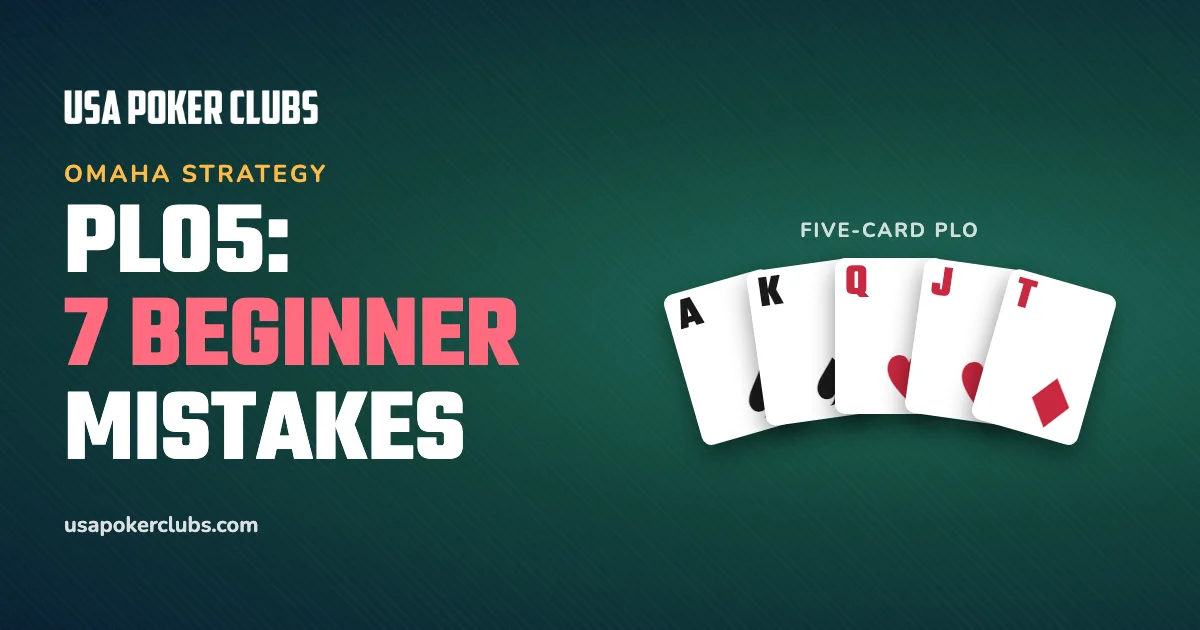
PLO5 Strategy: 7 Beginner Mistakes That Cost You Money

Good PLO5 strategy mostly comes down to avoiding a handful of expensive habits: playing too many hands, chasing non-nut draws, and overvaluing medium-strength made hands. Five-card Pot-Limit Omaha gives everyone more combinations, so the average winning hand is stronger and second-best hands lose big pots. Fix the seven mistakes below and you'll be ahead of most players in the PLO5 games you find in online poker clubs.
If you need a refresher on the rules (you still use exactly two hole cards and three board cards), see our ClubGG games and hand rankings guide. This post assumes you know how the game works and want to stop losing money at it.
PLO5 vs PLO4: what actually changes
Adding a fifth hole card looks like a small tweak. It isn't. Here's how the two games compare:
| PLO4 (regular PLO) | PLO5 | |
|---|---|---|
| Hole cards | 4 | 5 |
| Two-card combinations per hand | 6 | 10 |
| Possible starting hands | 270,725 | 2,598,960 |
| Preflop equity gaps | Small | Even smaller |
| Typical winning hand at showdown | Strong | Stronger; nut hands win more often |
| Value of draws and blockers | High | Higher |
| Variance | High | Higher |
The key number is 10. Every opponent in a PLO5 hand has ten two-card combinations to make a hand with, versus six in PLO4. That's why hands that are fine in four-card Omaha, like a medium flush or a set on a wet board, are much weaker in 5 card PLO strategy.
Mistake 1: Overvaluing hands with a dangler
A dangler is a card that doesn't work with the rest of your hand. Take Q♥ J♥ T♦ 9♦ 3♣. The first four cards are a great double-suited rundown. The 3♣ adds almost nothing: it doesn't connect, it doesn't add a useful suit, and it uses up one of your five slots.
Beginners see "five cards" and assume more cards means a stronger hand. In PLO5, the best PLO5 starting hands are the ones where all five cards work together, such as J♠ T♠ 9♥ 8♥ 7♣, which can make straights in many directions and has two suits to draw to.
The fix: before you put money in, ask how many of your ten combinations are actually useful. A hand with four strong cards and a dangler is playable from late position, but it's not a hand to build a big pot with preflop.
Mistake 2: Playing non-nut flushes and low straights
This is the single most expensive leak in Omaha, and it's worse in PLO5.
Flush example: you hold K♥ 8♥ 7♠ 6♣ 4♦ and the board runs J♥ 9♥ 5♣ 2♥. You have the king-high flush. In Hold'em that's a monster. In PLO5, when there's a bet and a raise in a multiway pot, someone holding the A♥ with another heart is a very real possibility, and you'll lose a big pot to the nuts.
Straight example: the flop is 9♣ 8♦ 7♠ and you hold 6♥ 5♥ K♠ Q♦ 2♣. You flopped a straight, but it's the low end (5 through 9). Anyone holding T-J has the nut straight, and T-6 beats you too. With ten combinations per player, someone holding one of those hands in a multiway pot is common.
The fix: in multiway pots, treat non-nut flushes and the low end of straights as bluff catchers, not stack-off hands. Draw to the nuts whenever you can.
Mistake 3: Ignoring blockers
A blocker is a card in your hand that makes a specific holding impossible or less likely for your opponents. Because PLO5 players hold so many cards, blockers matter more than in any game you've played.
Example: the board is K♠ 8♠ 4♠ 3♦ J♣ and your opponent bets the pot on the river. You hold A♠ Q♦ Q♣ 7♥ 6♥. You don't have a flush, but you hold the A♠, so nobody can have the nut flush. Against a tight player who only bets the pot with very strong hands, a pair of queens is still an easy fold. Against an aggressive player, though, your blocker removes the hand they'd most like to represent, which makes a bluff from them more likely and gives you a reason to call that your actual hand strength doesn't.
The reverse matters too. If you're thinking about bluffing the river, the best bluffs hold a card that blocks the nut hand you're representing, so your opponent is less likely to have it and call you.
The fix: before any big decision on the turn or river, check which nut hands you block and which you don't.
Mistake 4: Overplaying sets and two pair multiway
In Hold'em, flopping a set feels like you've won the pot. In PLO5, a set on a wet board can be a coin flip or worse.
Example: you hold 9♦ 9♣ A♠ K♥ 4♣ and the flop is 9♥ T♥ J♠. You have top set, but the board is coordinated. An opponent with Q♥ 8♥ K♦ 7♣ 2♠ already has a straight (8 through Q) plus a flush draw. You need the board to pair, or one of a few specific cards, to win, and you're behind for now.
Two pair is even weaker. Top two pair in a three-way PLO5 pot on a connected board is often just a hand that pays off someone else.
The fix: on dry boards, sets are strong and you should build the pot. On wet, connected or two-tone boards, play sets more carefully when there's heavy action from multiple players, and fold two pair more often than feels natural.
Mistake 5: Calling too wide preflop
Because PLO5 equities run close together, beginners reason that almost any hand is "only a slight underdog" and call everything. That's how you end up in a lot of multiway pots out of position with hands that make second-best holdings.
The problem isn't the preflop equity. It's what happens after the flop. Hands like K♣ 9♦ 6♥ 4♠ 2♣ (unsuited, unconnected, no aces) flop weak draws and medium pairs, then cost you money on every street.
Better PLO5 starting hands to look for:
- Suited aces, ideally with a second suit (A♠ x♠ plus two cards of another suit)
- Connected rundowns with few gaps (J-T-9-8 type structures)
- Big pairs with connectors and suits, like A♥ A♣ K♥ Q♣ J♦
- Hands where all five cards work together
The fix: play tighter from early position, open more from the button and cutoff, and fold weak hands from the blinds even when the price looks cheap. The micro-stakes poker strategy principle of playing a solid, tight range applies here too.
Mistake 6: Misusing pot-limit sizing
Pot limit changes how you size bets. A pot-sized raise means you call the bet first and then raise the size of the new pot.
Preflop example: at $0.25/$0.50 blinds with no limpers, a pot-sized open is $1.75. That's the $0.50 call plus a raise of $1.25 (the small blind, big blind and your call added together).
Postflop example: the pot is $20 and your opponent bets $20. If you call, you're putting in $20 to win a final pot of $60, so you need about 33% equity. If you want to raise the pot, you call $20 (making the pot $60) and raise $60, for a total of $80.
Two common errors follow from not understanding this:
- Potting every street with medium hands. Pot-sized bets inflate the pot quickly. Three pot-sized bets will commit most stacks, which is a disaster with a non-nut hand.
- Checking strong hands to "trap." In PLO5, the turn and river change hand rankings constantly. If you check your set on a draw-heavy board, you give free cards to the many draws your opponents hold.
The fix: size up with strong hands that are vulnerable, use smaller bets (half pot to two-thirds pot) when you want to control the pot size, and check behind with medium-strength hands that can't stand a raise.
Mistake 7: Playing PLO5 on a Hold'em bankroll
PLO5 swings harder than any common cash game. Because so many all-ins are close to coin flips, you can play well for a long stretch and still be down several buy-ins.
Many players use a bigger bankroll for Omaha than for Hold'em, and PLO5 deserves at least as much cushion as four-card PLO. If you'd normally sit at a Hold'em game with a set number of buy-ins in reserve, plan on more for PLO5. Our poker bankroll management guide walks through how to set those numbers and when to move up or down.
Two related habits help:
- Run it twice when offered. It doesn't change your long-run results, but it smooths out the swings. See what running it twice means.
- Be careful with bomb pots. Many clubs on ClubGG run bomb pots in Omaha games, and in PLO5 they create big multiway pots with no preflop folding. Learn how a bomb pot works before you sit in a game that runs them.
PLO5 strategy checklist: how to play PLO5 better
Here's a quick checklist to take to the table:
- Fold hands with a dangler unless you're in late position and the pot is unraised.
- Draw to the nuts. Treat non-nut flushes and low straights as bluff catchers.
- Check your blockers before every big river decision.
- Slow down with sets and two pair on wet boards when facing heavy action.
- Tighten up from early position and the blinds.
- Know your pot-limit math and don't pot every street with medium hands.
- Use a bigger bankroll than you would for Hold'em.
Where to play PLO5 online
Not every club spreads PLO5, so check the game lineup before you join. The Massiv union lists PLO5 and PLO6 among its games, and Saloon is our listed club in that union. For every club we track, with Club IDs and stake levels, browse the club directory. If you're new to the app itself, start with our ClubGG guide for USA players.
Frequently Asked Questions
Is PLO5 good for beginners?
PLO5 is easy to learn but hard to play well, because hands run close together and pots get big fast. If you're new to Omaha, start with low stakes, play tight, and focus on nut hands until you're comfortable reading boards.
Is PLO5 more profitable than regular PLO?
It can be, because many recreational players play far too many hands in PLO5. But the swings are bigger, so your results take longer to settle and you need a deeper bankroll to ride them out.
Should you run it twice in PLO5?
Running it twice doesn't change your expected value, it only reduces variance. Since PLO5 all-ins are often close to coin flips, many players choose to run it twice when the option is offered. Our guide to running it twice explains how it works.
Can you bluff in PLO5?
Yes, but less often than in Hold'em. With five cards each, opponents connect with boards more often, so pick bluffs where you hold key blockers and the board makes it hard for them to have a strong hand.