
Run It Twice in Poker: How It Works and When to Do It

Run it twice means dealing the remaining community cards two times after players are all-in, with each run worth half the pot. It does not change your expected value, but it makes big all-ins less swingy because a single bad card can no longer cost you the whole pot. Most online club apps offer it in cash games, and once you understand the math, agreeing is usually an easy choice.
This guide covers how run it twice works, how the pot is split, why it reduces variance without changing EV, running it three times, and the etiquette around asking.
How does run it twice work in poker?
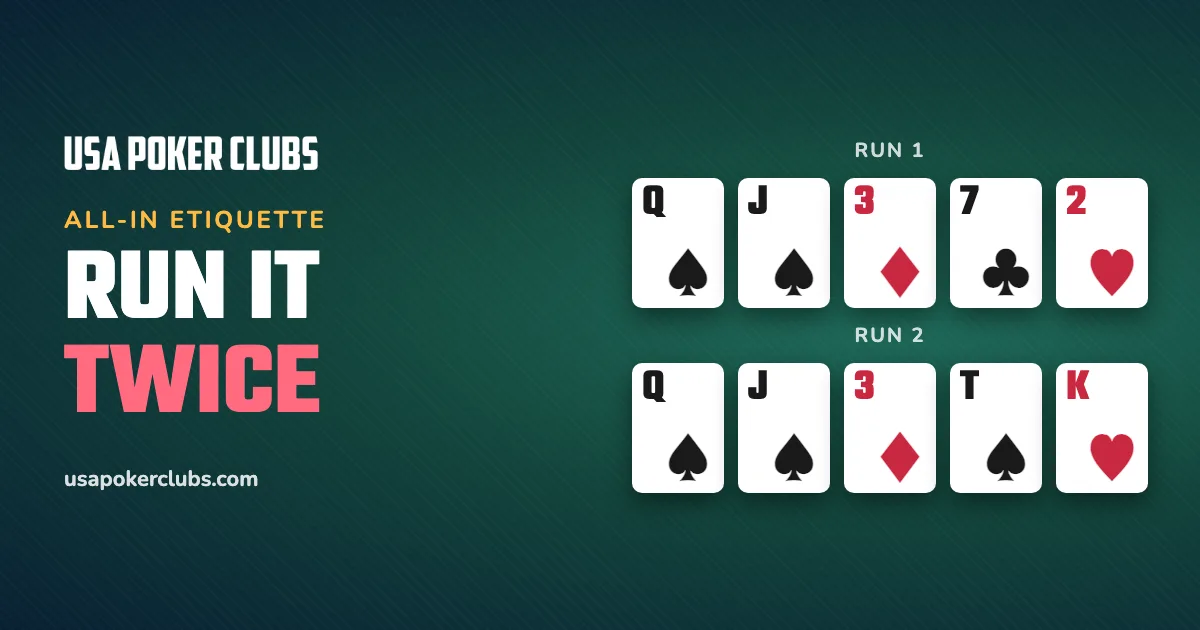
Once all the money is in and no more betting is possible, the players involved can agree to run the board more than once. The process is:
- All-in and called. No further betting is possible, so the cards on the board are the only thing left to decide.
- Players agree. Everyone involved in the all-in has to say yes. If anyone declines, the hand runs once.
- The first run is dealt. The remaining board cards come out as normal: flop, turn and river if you were all-in preflop, or just the river if you were all-in on the turn.
- The second run is dealt from the same deck. The cards from the first run stay out of the deck, so the second run uses fresh cards.
- Each run pays half the pot. The best hand on run one wins half; the best hand on run two wins the other half.
Only the cards that hadn't been dealt yet are run again. If you were all-in on the flop, the flop stays the same on both runs and only the turn and river are dealt twice.
How the pot splits
| Result | Your share of the pot |
|---|---|
| Win both runs | 100% (you scoop) |
| Win one run, lose the other | 50% |
| Lose both runs | 0% |
| Tie one run, win the other | 75% |
Split pots within a run are handled normally, so a tie on one run splits that run's half. Odd chips are handled by the table's rules.
Does running it twice change EV?
No. Running it twice does not change your expected value at all. It only changes how spread out your possible results are, which is what poker players call variance.
Here is the simplest way to see it. Each run is worth half the pot, and your chance of winning each run is the same as your chance of winning a single run. Two halves at the same win rate add up to exactly what one full run is worth.
A worked example
You get all-in on the turn and the pot is $200. Your opponent has 11 outs. With 44 unseen cards from your point of view, they hit on the river 11 / 44 = 25% of the time, so you are a 75% favorite.
Run it once:
- 75% of the time you win $200.
- 25% of the time you win $0.
- Expected value: 0.75 × $200 = $150.
Run it twice: each run is worth $100 and you win each one about 75% of the time.
- Win both: about 0.75 × 0.75 = 56.25% of the time, you get $200.
- Win one: about 2 × 0.75 × 0.25 = 37.5% of the time, you get $100.
- Lose both: about 0.25 × 0.25 = 6.25% of the time, you get $0.
- Expected value: (0.5625 × $200) + (0.375 × $100) = $112.50 + $37.50 = $150.
Same $150 either way. What changed is how often you walk away with nothing: one run in four when you run it once, about one in sixteen when you run it twice.
The probabilities for two runs are close approximations. The second river comes from a deck that is one card smaller, so the two runs are not perfectly independent. That shifts the chance of the "win both" and "lose both" outcomes a little, but it can never change the EV: before any cards are dealt, each run is equally likely to be any of the unseen cards, so each run's win rate is still exactly 75%.
Why lower variance matters
If EV is the same, why bother? Because smaller swings are easier to live with:
- Your bankroll lasts longer. Fewer full-pot losses mean shallower downswings. That matters most when you play close to your limits, which our poker bankroll management guide helps you avoid.
- You tilt less. Losing a 75% pot in one card stings. Losing half of it is easier to shrug off.
- Your results track your decisions. Over a short session, running it twice brings your results closer to your actual edge.
Run it three times and more
Running it three times works the same way: the remaining cards are dealt three times and each run is worth a third of the pot. Some apps let players run it more times than that when everyone agrees. EV stays the same no matter how many runs you choose; each extra run just smooths the results a bit more.
| Run once | Run it twice | Run it three times | |
|---|---|---|---|
| Share of pot per run | 100% | 50% | 33.3% |
| Changes your EV? | No | No | No |
| Variance | Highest | Lower | Lowest of the three |
| Chance of losing everything as a 75% favorite | 25% | About 6% | About 1.5% |
| Time to deal | Fastest | A little slower | Slowest |
| Where you'll see it | Everywhere | Most cash games | Some cash games and apps |
The last numbers assume independent runs (0.25 × 0.25 and 0.25 × 0.25 × 0.25), so treat them as close estimates.
When to agree to run it twice and when to decline
Since EV is identical, the decision is about comfort and practical factors, not about winning more.
Agree when:
- The pot is big relative to your bankroll or your session buy-in.
- You are prone to tilt after a bad beat.
- You are playing in a high-variance game such as PLO, a bomb pot or a deep-stacked table.
Declining is reasonable when:
- The pot is small relative to your bankroll, so the swing doesn't matter to you.
- You want the hand to finish quickly.
- You simply prefer one run. That's your right, and it costs you nothing in EV.
A common myth is that the favorite should always run it once and the underdog should always ask for twice. The math says otherwise: neither player gains or loses EV from the choice. Some players decline to make opponents sweat the variance, but that is psychology, not math.
Run it twice etiquette
Most of the friction at the table comes from etiquette, not math:
- Ask once, accept the answer. If someone declines, don't argue or needle them in chat.
- Be consistent. Agreeing only when you are behind and declining when you are ahead looks bad, even though it doesn't change EV.
- Don't slow-roll the decision. On apps, there is usually a short timer to choose. Make your choice promptly.
- Know the house rules. Some games only allow running it twice heads-up, or set a maximum number of runs.
How club apps handle running it multiple times
On online club apps, run it twice is a built-in option rather than a verbal agreement. Typically, when players are all-in, the app asks each player in the hand whether they want to run it more than once, and the board is run multiple times only if everyone agrees. The app then deals the runs, splits the pot automatically and shows each board side by side.
Whether the option is turned on, and how many runs are allowed, is up to the club and the table. On ClubGG, clubs can configure "run it multiple times" options for their tables, so check the table info before you sit down. Our complete ClubGG guide covers how the app works, and the ClubGG games and hand rankings guide covers the game types where you will use it most.
If you are looking for a cash game to try it out, browse our club directory for Club IDs, stakes and game types, or start with a 24/7 club like Saloon in the Massiv union. For more strategy, read our micro stakes poker strategy guide.
Frequently Asked Questions
Can you run it twice in a poker tournament?
Generally no. Running it twice is a cash game option. Tournament hands are dealt once because chips decide who busts and who moves up the pay ladder.
Does running it twice affect the rake?
In general, no. The rake is taken from the total pot once, and the remaining pot is then divided between the runs. The exact rake rules depend on how the club has set up the table.
Can you run it twice with more than two players all-in?
It depends on the game. Some rooms and apps only offer the option heads-up, while others allow it multiway when every all-in player agrees. Check the table rules in your club.
Is running it twice rigged on poker apps?
No more than running it once. Each run is dealt from the same shuffled deck with the used cards removed. If you have questions about fairness on ClubGG, see our guide is ClubGG rigged?