
Poker Bankroll Management for Club Players

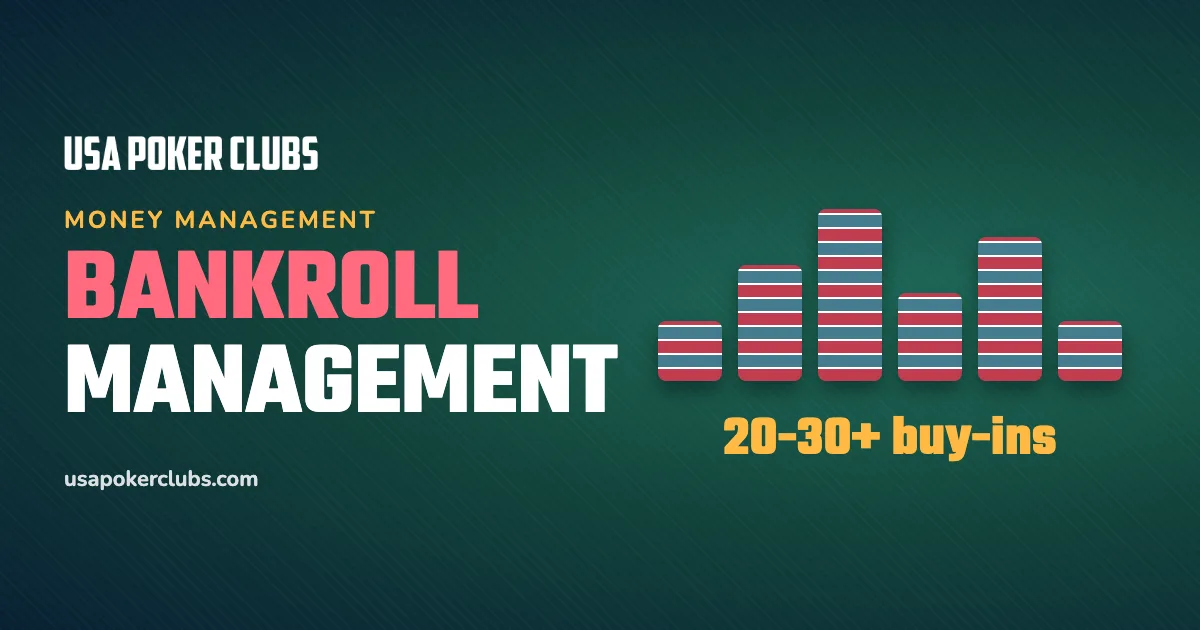
Poker bankroll management means keeping a dedicated pot of money for poker and only playing stakes that pot can survive. A common rule of thumb is 20-30 buy-ins for no-limit hold'em cash games, more for PLO, and 100 or more for tournaments. In an online club, it also means never playing on credit you can't cover when the weekly settlement comes around.
Below are the buy-in guidelines, the club-specific traps, and simple rules for moving up, moving down and quitting a bad session.
Why poker bankroll management matters
Poker has variance. A solid player can lose for days or weeks while making correct decisions, simply because the cards ran badly. If your bankroll is too small for your stakes, a normal downswing wipes you out before your edge has time to show up.
Good bankroll management does three things:
- It keeps you in the game. You can lose ten buy-ins in a row and still have money to play.
- It protects your decisions. When the money on the table is a small slice of your roll, you're not scared to call with the right hands or fold when you're beat.
- It protects your real life. Poker money stays poker money. Rent, bills and savings never end up on the felt.
That last point matters most for recreational players. You don't need to be a pro to benefit from a bankroll; you just need a number you've decided you can afford to lose.
How many buy-ins do I need?
The table below shows common rules of thumb. They are starting points, not laws, and many experienced players use more conservative numbers.
| Game format | Common guideline | Conservative / pro-style | Why |
|---|---|---|---|
| No-limit hold'em cash | 20-30 buy-ins | 40+ buy-ins | Moderate swings; one buy-in = 100 big blinds |
| PLO cash (4-card) | 40-60 buy-ins | 80+ buy-ins | Hand equities run closer, so swings are much larger |
| PLO5 cash (5-card) | 50-80 buy-ins | 100+ buy-ins | Even closer equities and bigger multiway pots |
| Sit & Gos | 30-50 buy-ins | 75+ buy-ins | Fewer players, but you still lose most of them |
| Multi-table tournaments | 100+ buy-ins | 200+ buy-ins | Most of your profit comes from rare deep runs |
A quick worked example
Say you set aside $1,000 for poker and want to play no-limit hold'em cash.
- At 25 buy-ins, your maximum buy-in is $40. That's a full 100-big-blind stack at $0.20/$0.40.
- At $0.50/$1, a 100bb buy-in is $100. Your $1,000 is only 10 buy-ins, which is too thin for most players.
The same $1,000 for PLO at 50 buy-ins means $20 buy-ins. For tournaments at 100 buy-ins, you'd stick to $10 events and smaller.
Bankroll for PLO and PLO5
The bankroll for PLO needs to be bigger because the hands run so close together. In hold'em, an overpair is often a big favorite. In Omaha, a strong made hand facing a big draw can be close to a coin flip, and you'll get all-in in those spots far more often. Five-card PLO pushes this further because everyone has more combinations.
If you're coming from hold'em, drop down a stake or two when you start Omaha. Our PLO5 beginner mistakes guide covers the strategy side, and ClubGG game types explained covers the rules.
Poker bankroll for beginners
If you're new, start smaller than the table suggests. Beginners usually don't have a proven edge yet, so the bankroll has to absorb mistakes as well as variance.
A sensible beginner plan:
- Pick an amount you'd be comfortable losing completely, like money you'd spend on a hobby.
- Play the smallest stakes available until you've logged a meaningful number of hands.
- Use our micro stakes poker strategy guide to build a simple, solid game before moving up.
If you're still looking for a game, our best low-stakes ClubGG clubs page lists clubs that spread micro and low stakes.
Club-specific factors most guides ignore
Most bankroll advice was written for regulated poker sites where you deposit first and play second. Club poker works differently, and that changes how you should protect your money.
Weekly settlement
Most clubs settle up with players weekly, through an agent, using off-app payment methods. Your chip balance on the app and the actual cash in your bank account aren't the same thing until settlement happens. If you're unfamiliar with how that works, read how ClubGG deposits and cashouts work before you play.
For bankroll purposes, the rule is simple: count only money you control. Chips you're owed from this week aren't in your bankroll yet. Treat them as pending until the settlement actually lands.
Agent credit
Some agents extend credit, letting you play now and pay at the end of the week. This is the single biggest bankroll risk in club poker. Credit makes it easy to lose more than you planned because there's no balance hitting zero to stop you.
Never play on credit you can't cover. If you do accept credit, cap it at an amount already sitting in your poker bankroll, so a losing week is paid in full on settlement day without touching rent money. If you notice yourself chasing losses on credit, stop and ask the agent to remove the line.
Keep the club bankroll separate
Keep your poker money in its own account or wallet, separate from your everyday spending. Pay losses from it and send winnings into it. This makes tracking easy and stops "just one more top-up" from coming out of your checking account.
There's also no regulator or deposit insurance in club poker. If a club stops paying, there's no one to complain to. Don't park more money with any club or agent than you need for the current week, and test a small cashout early with any new club.
Moving up in stakes (and moving back down)
Moving up in stakes should be a decision you make in advance, not one you make after three beers and a good run. Set your rules while you're calm.
Simple move-up and move-down rules
| Situation | Rule of thumb |
|---|---|
| Move up | You have your full buy-in count for the next stake (e.g. 25+ buy-ins at the new level for NLH cash) |
| Take a shot | Set aside 3-5 buy-ins for the higher stake; if you lose them, go back down with no shame |
| Move down | Your roll drops below about 20 buy-ins for your current NLH stake (or your chosen minimum for PLO/MTTs) |
| Stay put | You're winning but haven't reached the next threshold yet |
Shot-taking is fine. Many players build their way up exactly this way. The key is deciding the size of the shot before you sit down, and stepping back down the moment those buy-ins are gone.
Moving down isn't failure. It's the system working. Players who refuse to move down are the ones who go broke.
Don't let a big win fool you
One great night can double a small roll. That doesn't mean you've outgrown the stakes. Before moving up, make sure your results over a larger sample support it, not just one heater.
Tracking your results
You can't manage what you don't measure. Keep a simple log after every session:
- Date, game (NLH, PLO, PLO5, tournament) and stake
- Buy-in total and cash-out total
- Hours played
- Rakeback received that week
- A one-line note on your mental state ("tired", "tilted after a cooler")
A spreadsheet or notes app is enough. After a month or two, you'll see which games and stakes are actually profitable for you, and which ones just feel fun. That note about your mood often turns out to be the most useful column.
Track by week as well as by session. Since clubs settle weekly, your weekly number is the one that shows up in your real account.
Rakeback is part of your win rate
Rake is the small cut the club takes from each pot or tournament entry, and rakeback is the share some clubs return to players. For a micro or low-stakes player, rakeback can make a real difference to results.
Example: if you pay $40 in rake over a week and your club returns 50%, that's $20 back. For a break-even player, that $20 is the entire profit. Over a year it adds up.
When you track results, record rakeback as a separate line so you know whether you're beating the games or just the rake. Our ClubGG rakeback guide explains how it works and what's typical. Rakeback ranges vary by club; you can compare them in the club directory. For example, Saloon in the Massiv union lists 25-70% rakeback.
Stop-loss and tilt rules
Tilt, meaning playing emotionally after a bad beat or a losing stretch, burns through bankrolls faster than bad cards do. A few firm rules help:
- Session stop-loss. Quit for the day after losing a set number of buy-ins, such as 3 in NLH cash. Decide the number before you start.
- Weekly stop-loss. Cap what you can lose in one settlement week. If you hit it, you're done until the next week.
- No reloading in anger. If you just lost a big pot and want to rebuy immediately, take a five-minute break first.
- Quit when tired. Late-night sessions on a phone are when the worst calls happen.
- Watch the side games. Features like running it twice reduce variance on a single all-in, but they don't change expected value. Bomb pots and other action games add variance, so budget for them.
If poker stops feeling like a hobby, or you're hiding losses or borrowing to play, the National Council on Problem Gambling has free, confidential help.
Putting it together
Poker bankroll management comes down to a handful of habits: set aside money you can afford to lose, play stakes it can survive, never play on credit you can't cover, and track your results honestly. Do that and a bad week stays a bad week instead of a real problem.
For more on how club poker works, start with our complete ClubGG guide.
Frequently Asked Questions
What percentage of my bankroll should I buy in for?
For no-limit hold'em cash games, a common guideline is to keep a single buy-in at about 3-5% of your poker bankroll, which works out to 20-30 buy-ins. For PLO and tournaments the percentage per game should be smaller because the swings are bigger.
Can I start playing poker with $100?
Yes, as long as you treat the $100 as money you can afford to lose and play micro stakes where it covers 20 or more buy-ins. That usually means the smallest cash games or very cheap tournaments, not a single $50 or $100 table.
Should I withdraw my poker winnings or keep them in my bankroll?
Both are reasonable. Many recreational players set a target bankroll for their stake and cash out anything above it each week, which keeps the roll stable and turns wins into real money. Just don't withdraw so much that you drop below your minimum buy-in count.
Does bankroll management matter if I only play for fun?
Yes. Even if winning isn't the goal, a set budget and a stop-loss keep poker affordable and stop one bad night from turning into a debt you owe your agent at settlement time.