Micro-Stakes Poker Strategy: How to Beat Low-Stakes Club Games

The best micro stakes poker strategy is simple: play a tight-aggressive range, bet your good hands for value, and stop bluffing players who never fold. Low-stakes club games are full of recreational players who call too much and fold too little, and the way to beat them is to give them chances to pay you off, not to make fancy plays.
This guide focuses on No-Limit Hold'em cash games in online poker clubs. If you're still choosing where to play, our ranking of the best low-stakes ClubGG clubs covers that. Here, we'll focus on how to win once you're seated.
Why micro stakes NLH is beatable
Most players at the lowest stakes are there for fun. That's a good thing for you. Their most common leaks are predictable:
- Playing too many hands preflop, especially limping
- Calling down with weak pairs and draws
- Rarely bluffing on the river, so big river bets usually mean a strong hand
- Playing the same way no matter who's at the table
Each of those leaks has a direct counter, and none of them requires advanced theory. The players who win at micro stakes are usually the ones with the most discipline, not the most creativity.
Micro stakes poker strategy starts with tight-aggressive play
Tight-aggressive (TAG) means you play fewer hands than most of the table, and when you do play, you raise instead of calling. Raising gives you two ways to win: your opponent folds now, or you have a better hand later.
Position matters as much as your cards. You get more information when you act last, so play tighter from early position and widen up on the button and cutoff.
Preflop checklist
Use this as a starting point at a 6-max or full table. Adjust as you learn your opponents.
| Situation | What to do | Example hands |
|---|---|---|
| Folded to you, early position | Raise to about 3 big blinds with a tight range | 77+, AJs+, AQo+, KQs |
| Folded to you, middle position | Raise with a slightly wider range | 55+, ATs+, AJo+, KJs+, QJs, JTs |
| Folded to you, cutoff or button | Raise wide; you have position | Any pair, suited aces, suited broadways, suited connectors, AT+, KJ+ |
| One or more limpers ahead | Raise to isolate with strong hands; fold weak ones | 88+, AJ+, KQ, suited broadways |
| Facing a single raise | 3-bet for value, call with pairs and strong suited hands in position | 3-bet QQ+, AK; call 22-JJ, AQ, suited broadways |
| Small blind, folded to you | Raise or fold; don't just complete | Raise good hands, fold junk |
| Big blind vs a late-position raise | Defend hands that play well after the flop | Pairs, suited aces, suited connectors, broadways |
Two habits from this table will save you the most money: never limp from early position, and fold offsuit trash from the blinds even when the price looks cheap.
Isolate limpers instead of limping behind
Limpers are usually the weakest players at the table. When one limps, raise to separate them from the rest of the field and play a pot against them in position.
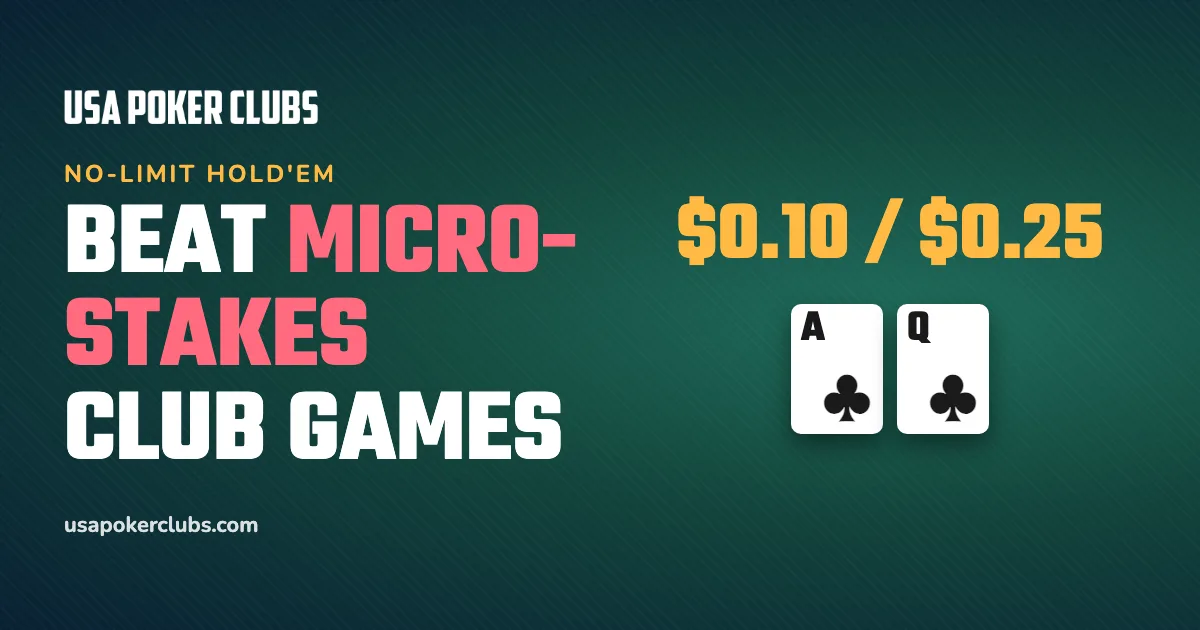
A good rule of thumb is about 4 big blinds plus 1 big blind for each limper. At $0.10/$0.25 with two limpers, you'd raise to about $1.50 with a hand like A♥ Q♣ on the button: $1.00 for the base raise plus $0.25 for each limper.
If you get called, you're heads up or three-way with position and, usually, the better hand. That's the most profitable spot in micro stakes poker.
Value bet thinner than feels comfortable
Recreational players call with second pair, third pair and sometimes ace-high. That means you should bet more hands for value, not fewer.
Example: you raise with A♠ J♦ on the button and a loose player calls from the big blind. The flop is K♣ J♥ 7♦. You bet, they call. The turn is the 4♠ and you both check. The river is the 2♣ and they check again.
Many players check behind here, afraid of a king. Against a calling station, betting about half the pot is better. They'll call with any jack, many sevens and sometimes a pocket pair, and you're ahead of almost all of those hands. If they raise, you can fold: passive players rarely raise the river as a bluff.
The principle is simple. If a worse hand will call, bet.
Don't bluff calling stations
This is the other side of the same coin. If a player calls too much, your bluffs lose money. A missed flush draw against someone who never folds a pair is a check-and-give-up, not a triple barrel.
Save your bluffs for tighter players and for boards where your opponent's likely hands are weak. Against the loose, passive players who make up much of the micro-stakes player pool, you can bluff very rarely and still win comfortably.
Bet sizing: make them pay
Bigger bets with strong hands are one of the easiest ways to exploit recreational players. Many of them decide whether to call based on their hand, not the price.
- With strong hands: bet two-thirds to full pot. Weak players will often call anyway.
- With thin value hands: bet half pot or a little less so worse hands can call.
- When you're calling: know your pot odds. If the pot is $10 and your opponent bets $5, you're calling $5 to win a total of $20, so you need to win 25% of the time.
A big river bet or raise from a player who has been passive all hand is usually the nuts or close to it. The easiest money you'll ever save at micro stakes is folding there.
How to play multiway pots
Club games often have several players seeing every flop. Multiway pots change your strategy:
- Bluff less. With three or four opponents, someone usually has a piece of the board.
- Need stronger hands to commit. One pair is rarely good enough for a big pot against several players.
- Value bet strong hands hard. More players means more chances that someone calls with a second-best hand.
- Draw to the nuts. A non-nut flush draw in a five-way pot can cost you a stack.
The same logic is even stronger in Omaha. If your club spreads Pot-Limit Omaha, our post on PLO5 strategy mistakes covers multiway play in five-card games, and how bomb pots work explains the forced multiway pots many clubs run.
Use notes and table selection
Most of your edge comes from knowing who you're playing against. If your poker app lets you tag or write notes on players, use it. If it doesn't, keep a simple list on paper. Useful notes are short:
- "Calls down with any pair"
- "Only raises river with the nuts"
- "Limps a lot, folds to raises"
- "Aggressive, will bluff"
Table selection matters just as much. Look for tables where lots of players see the flop and pots are big relative to the blinds. If a table is full of tight regulars who rarely limp, find another one. In online clubs, you can usually see several tables running at your stake, so pick the softest one.
Rake also matters at the smallest stakes, where it takes a bigger bite out of your winnings relative to the pot. Ask about rakeback before you join; our ClubGG rakeback guide explains how it works.
Tilt control and session discipline
Low stakes don't mean low emotions. Most micro-stakes players who could win don't, because they play their worst poker after a bad beat.
Set a few rules before you sit down:
- A stop-loss. Pick a number of buy-ins you'll lose before quitting for the day, and stick to it.
- A time limit. Long sessions make you sloppy, especially on a phone.
- No moving up to "win it back." Chasing losses at higher stakes is the fastest way to empty a bankroll.
- Quit when you notice tilt. If you're replaying a bad beat in your head, you're not focused on the current hand.
Proper bankroll management makes all of this easier. Read our poker bankroll management guide to set your buy-in rules and decide when to move up.
How to beat micro stakes: the short version
These are the low stakes poker tips that matter most:
- Play tight-aggressive and use position.
- Raise limpers; don't limp behind them.
- Value bet thin against players who call too much.
- Don't bluff calling stations.
- Size up with strong hands and fold to big river raises from passive players.
- Take notes and choose the softest tables.
- Protect your bankroll and quit when you're tilting.
If you're ready to play, browse our club directory for Club IDs and stake levels. Red Carpet and Frontier both list micro and low stakes, and our ClubGG guide covers getting set up on the app.
Frequently Asked Questions
How many buy-ins do you need to play micro stakes?
It depends on the game and how much variance you can stomach, but most players keep a few dozen buy-ins for No-Limit Hold'em cash games and more for Omaha. Our poker bankroll management guide covers how to set your number.
Is 6-max or full ring better at micro stakes?
Both are beatable. Full ring is a little easier for tight beginners because you can wait for good hands, while 6-max puts you in the blinds more often and rewards playing more hands in position.
Should beginners play cash games or tournaments at micro stakes?
Cash games are usually better for learning because the stack depths stay consistent and you can leave whenever you want. Tournaments are fun but have bigger swings and long sessions you can't easily walk away from.
What stakes count as micro stakes in a poker club?
There's no fixed rule, but micro stakes usually means blinds up to about $0.10/$0.25. Ask your club how chips convert to dollars, and see our games and stakes guide for typical levels.